
7 Critical Features Every Home Service Website Needs to Double Its Inbound Calls
Most home service websites have one quiet problem: they look like a business but function like a brochure. Visitors land, scroll for five seconds, and leave without calling. The truth is, website design for home services isn’t about looking good — it’s about engineering every element of the page around one outcome: getting that customer to pick up the phone.
If your website isn’t producing consistent inbound calls, it’s not a traffic problem. It’s a conversion problem. Here are the 7 features that fix it.
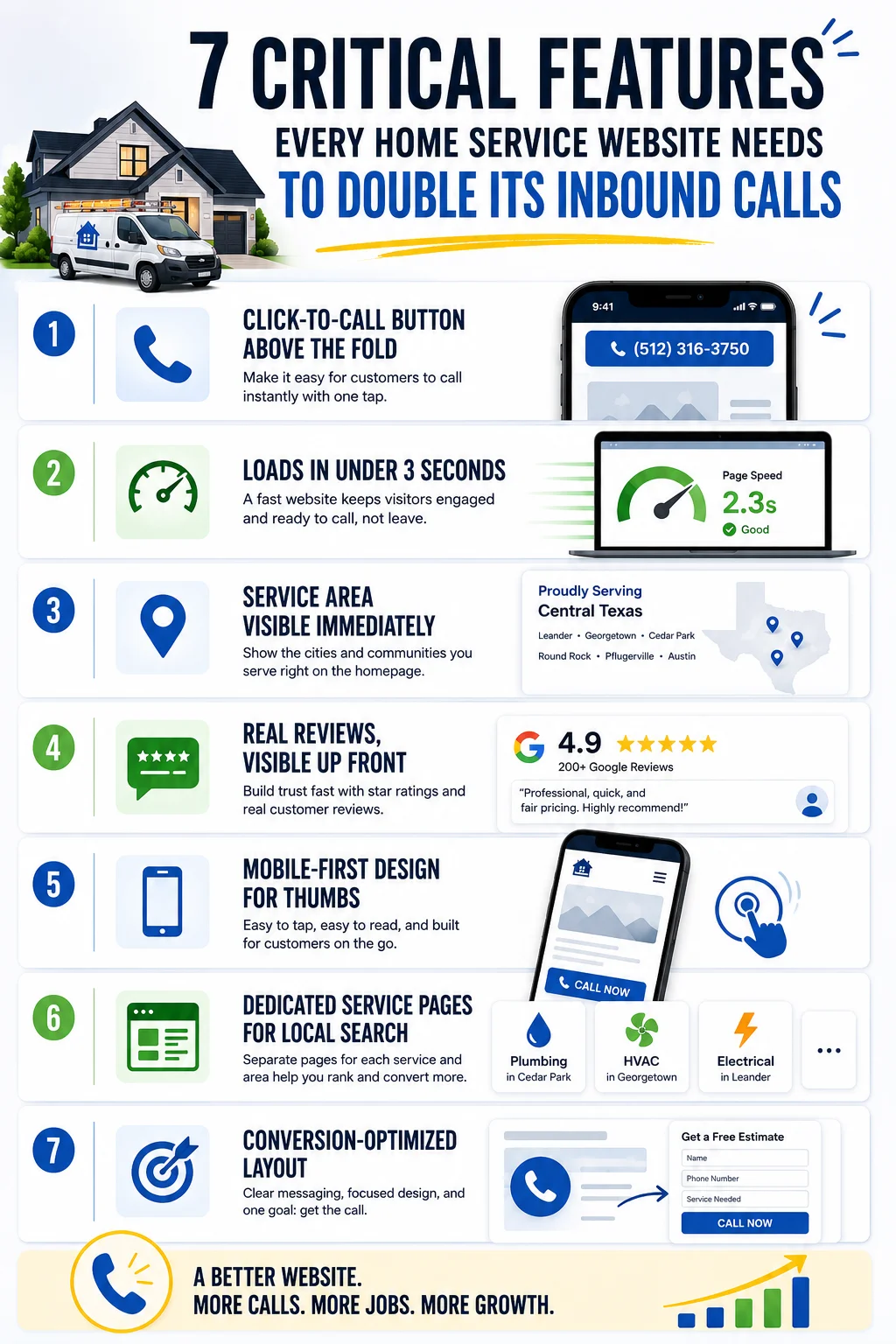
Feature #1: A Click-to-Call Button Above the Fold
Over 60% of home service searches happen on a mobile phone. That customer isn’t sitting at a desk — they have a leaking pipe, a dead AC unit, or a car stuck on the side of I-183.
They need to call someone right now. If your phone number isn’t a tappable button at the very top of your page, you’ve already lost a chunk of those customers to whoever made it easier. One button. Top of the page. Always visible. That single change produces more calls than almost any other website fix.
Feature #2: A Homepage That Loads in Under 3 Seconds
Speed isn’t a technical detail — it’s a conversion factor. A one-second delay in page load time can drop conversions measurably, and in home services where the customer has urgent intent, a slow site means they’re already on your competitor’s page.
A home service website that generates calls loads fast on mobile, on every network, every time. No bloated page builders, no uncompressed images, no render-blocking scripts that make a customer wait while your header loads.
Feature #3: Your Service Area on the Homepage — Immediately
Customers make a decision in under 60 seconds. One of the first questions they’re asking: do these people even come to my area?
If a homeowner in Leander or Georgetown has to scroll, click, or search to find out whether you serve them — most won’t bother. Your service area needs to be visible on the homepage, above the fold, without any effort on their part.
Named cities. Specific communities. Not vague language like “greater Central Texas area.” Real place names that make the customer say yes, that’s me.
Feature #4: Real Reviews, Visible Without Scrolling
Trust is the only thing standing between a customer and a call to someone they’ve never met. In 2026, that trust is built through reviews — and it has to happen fast.
Local trust signals home service website visitors respond to aren’t buried in a footer or hidden on a separate testimonials page. They’re visible immediately: your Google star rating, review count, and two or three real customer quotes — right there on the homepage, before the customer has to think twice.
Businesses that display 4.8-star ratings with 150+ reviews prominently convert at significantly higher rates than those that hide their social proof. Show it first.
Feature #5: A Mobile-First Design Built for Thumbs, Not Mice
Most web designers build on a desktop and then “check” mobile as an afterthought. That’s backwards for a home service business.
A mobile website for home service business owners needs to be designed mobile-first — meaning buttons are large enough to tap, forms are short enough to complete with one hand, and the most important information requires zero pinching or zooming to read.
If your current website feels clunky on a phone, your customers feel it too. They just don’t tell you — they call someone else instead.
Feature #6: Service Pages Built for Local Search — Not Just SEO
Every service you offer deserves its own page. Not a section — a full page, built around the specific searches customers in your area actually use.
This is where contractor website design Central Texas done right separates from generic web design. A plumber in Cedar Park needs a page for “Cedar Park plumbing services” — not a single generic services page that Google can’t associate with any specific location.
Dedicated service-area pages do two things at once: they rank for the local searches that matter, and they give the customer landing on that page exactly what they were looking for. Both outcomes move the needle on calls.
Feature #7: A Conversion-Optimized Layout — Not a Pretty Design
This is the feature most web designers get wrong. Beautiful websites and converting websites are not the same thing.
A conversion optimized website for contractors is structured around a clear hierarchy: here’s what we do, here’s where we do it, here’s why you should trust us, here’s how to call us right now. Every element on the page serves that path. Nothing exists to fill space or look impressive.
That means short paragraphs. Clear headings. One call-to-action per section. A contact form that asks for the minimum information needed. No pop-ups that interrupt the call decision. No carousels that distract from the message.
Design choices that impress other designers often hurt conversion. Design choices that make it frictionless to call don’t always win awards — but they fill schedules.
The Honest Assessment Most Websites Fail
Run your current website through this checklist:
- Phone number clickable at the top on mobile?
- Page loads in under 3 seconds on a phone?
- Service area named specifically on the homepage?
- Reviews visible without scrolling?
- Mobile layout designed for thumbs?
- Separate pages for each service area?
- One clear call-to-action on every section?
If more than two of those are a no — your website is costing you jobs every single week. Not maybe. Definitely.
Frequently Asked Questions
How much does a home service website redesign cost?
It varies significantly by scope, but a properly built conversion-optimized site for a service business typically runs $2,000–$6,000. The better question: what’s one missed call per day worth in lost revenue over a year?
How long does it take to build a new home service website?
A focused build with clear scope takes 3–5 weeks. Agencies that drag projects past 8 weeks are usually juggling too many clients or starting from scratch without a proven framework.
Does my website design affect my Google rankings?
Yes — directly. Page speed, mobile usability, structured data, and site architecture are all ranking factors. A well-built site helps SEO. A poorly built one actively holds it back.
Can I just update my current website instead of rebuilding?
Sometimes. If the structure is sound and the main issues are speed, mobile layout, and missing service pages — updates work. If the website was built on an outdated platform, loads slowly by design, or has no local SEO structure at all, a rebuild produces better results faster.
What makes a home service website different from a regular small business website?
Urgency and mobile intent. Home service customers need someone now, they’re searching on a phone, and they’re making a decision in seconds. The website has to be built around those realities — not borrowed from a retail or professional services template.
Your Website Should Work as Hard as You Do
You’re on jobs all day. Your website should be generating the next call while you’re on the current one. That only happens when every element is built around conversion — not aesthetics, not ego, not what the designer thought looked modern.
Website design for home services is the foundation every other marketing channel builds on. Google Ads, Local SEO, Local Service Ads — they all send traffic to your website. If that website isn’t built to convert, you’re pouring money into a leaking bucket.
Ad Insight builds websites specifically for service businesses across Central Texas — designed to load fast, rank locally, and turn visitors into calls from the first day they’re live.
Call (512) 316-3750 | adinsight.org/contact-ad-insight-jonestown-tx/