PMax vs Search Ads for Service Businesses: Which Actually Wins for High-Intent Leads in 2026?
Google has been pushing Performance Max campaigns hard. Every account recommendation tab tells you to switch. Every Google rep says it’s the future. But when a Cedar Park HVAC company or a Georgetown plumber asks the real question — which campaign type actually makes my phone ring — the honest answer isn’t what Google’s marketing says. PMax vs Search Ads for service businesses is the most important Google Ads decision you’ll make in 2026, and the data is clear enough to call it.
Here’s the breakdown — no spin, no Google marketing language.
What Performance Max Actually Is
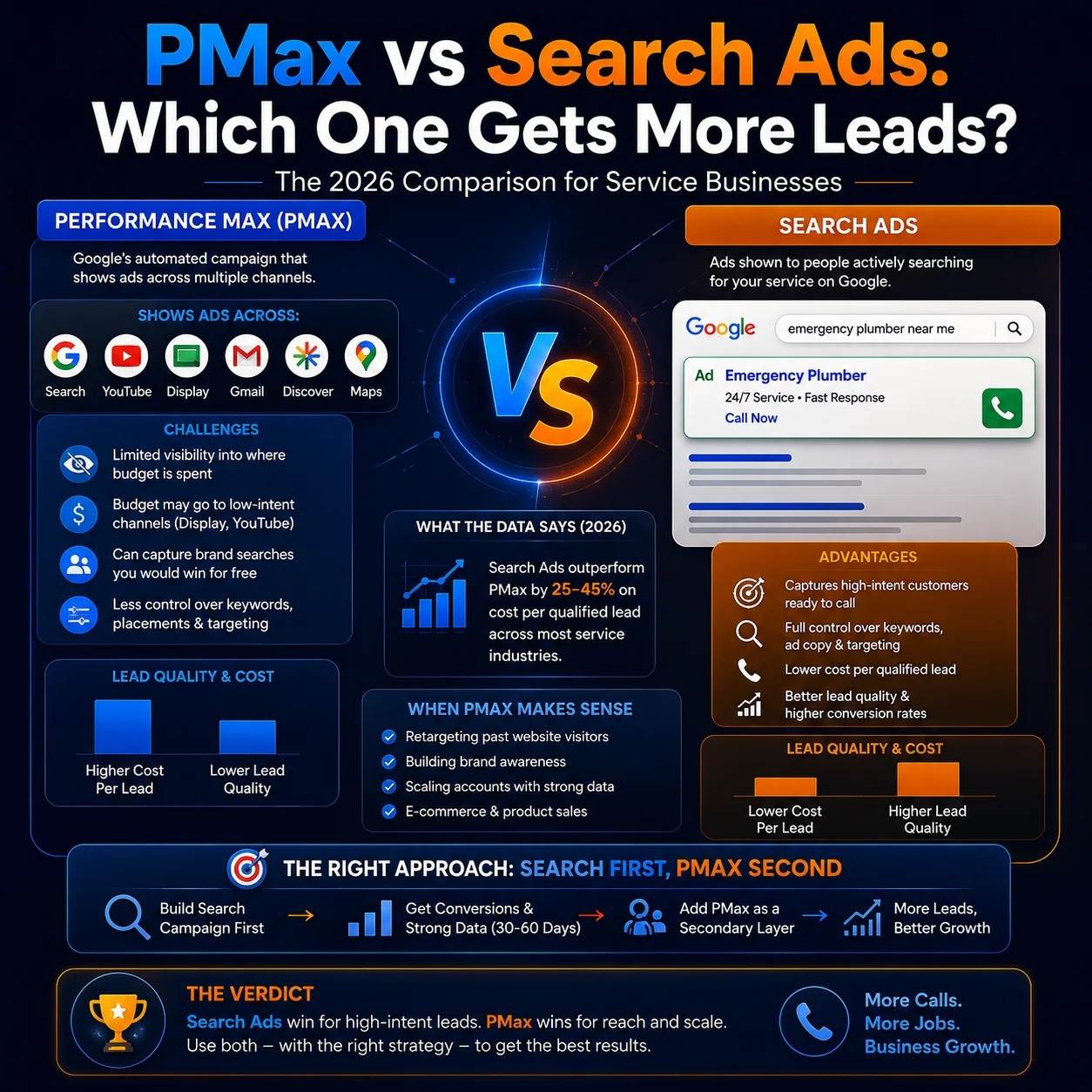
PMax is Google’s fully automated campaign type. You upload headlines, images, and audience signals. Google’s AI decides where your ads show — Search, YouTube, Display, Gmail, Discover, and Maps — all from one campaign.
It sounds efficient. In practice, it hands Google the wheel with minimal visibility into where your budget actually goes.
What Search Ads Actually Are
Search campaigns show your ads to people actively typing specific queries into Google. You control the keywords. You control the ad copy. You control the landing page. You control the geographic targeting.
When someone types “Emergency Electrician” into Google at 2:00 AM, they have a problem that needs an immediate solution — and Search Ads are built to pull that customer directly to you.
That’s the fundamental difference. Search captures demand that already exists. PMax tries to create it.
Need Expert Google Ads Service?
Contact Us Now!
The Core Problem With PMax for Service Businesses
Here’s what most service business owners discover too late.
Google does not clearly report how much of your PMax budget goes to each channel. Your campaign might be spending 70% of its budget on Display and YouTube inventory while you assume it is competing on Search.
For a roofing company in Round Rock with a $1,500 monthly budget, that’s not a small problem — that’s most of your ad spend going to channels that don’t make your phone ring.
What the 2026 Data Actually Shows
This isn’t opinion. Independent campaign data from 2026 is consistent across multiple sources.
Real data from 36 campaigns and 13 US lead generation accounts running between June 2025 and July 2026 shows that when measured on cost per qualified lead — not just cost per form fill — Search campaigns outperform PMax by 25–45% across most service industries.
That gap is significant. For a Google Ads lead quality Central Texas service business focused on real calls — not impressions, not clicks, not display views — Search wins on the metric that matters.
When PMax Does Make Sense
PMax isn’t useless. It just isn’t the right primary channel for most local service businesses.
Here’s where it earns its place:
- Retargeting — reaching past website visitors across Google’s full network
- Brand awareness — building name recognition in new service corridors
- Scaling accounts — once a Search campaign has strong conversion history and data to feed the automation
- E-commerce — where product feeds and broad reach outperform intent-based targeting
For most service-based small businesses with budgets under $2,000 per month, Search should be the primary engine because it captures high-intent demand with full control over keywords and negatives.
The Cannibalization Problem Nobody Warns You About
One of the most damaging and least discussed PMax issues for local service businesses: brand cannibalization.
PMax will often serve ads to people already searching your business name, claiming credit for clicks you would have won for free through your organic listing — inflating reported ROAS.
This makes PMax look like it’s performing when it’s actually just capturing demand your SEO and GBP were already generating at zero cost. A critical issue when evaluating any Performance Max campaign Central Texas contractors run alongside existing organic presence.
Google Search Ads: Still the Gold Standard for High-Intent Leads
Search campaigns remain the best way to capture demand from users actively searching for your product or service. When someone types “emergency plumber near me,” they are expressing clear purchase intent — and matching that intent with specific ad copy and a specific landing page produces conversion rates no other campaign type can match.
For Google Search Ads high intent leads Central Texas — the customer who needs someone right now, is searching from a phone, and is calling the first credible result they see — Search is the only campaign type built around that exact moment.
The Right Approach: Search First, PMax Second
The best Google Ads campaign type service business operators should use in 2026 isn’t one or the other — it’s a structured combination with clear roles.
Fund Search first for protection, then fund PMax for growth. Search is for demand that already exists — protect brand queries, high-intent non-brand terms, and short sales windows where message control matters. PMax is for growth after the account has enough conversion volume, asset depth, and feed quality to guide automation.
In practice for a Central Texas service business: build your Search campaign first, get it converting efficiently, accumulate 30–60 days of clean conversion data, then introduce PMax as a secondary layer for reach expansion — not as a replacement.
The Performance Max vs Search Ads Local Business Verdict
If you’re running a service business in Jonestown, Cedar Park, Leander, Georgetown, or anywhere across Central Texas — and your goal is inbound calls from customers with a real, urgent need:
Start with Search. Build it right. Let it convert.
Add PMax later as a brand and retargeting layer once your Search foundation is solid and your conversion data gives Google’s automation something real to optimize from.
Don’t let Google’s recommendations tab make this decision for you. The recommendation to switch to PMax serves Google’s revenue model — not your cost-per-lead.
Frequently Asked Questions
Does PMax replace Search campaigns?
No. PMax does not give you the keyword-level control, negative keyword management, or intent precision that dedicated Search campaigns provide. For high-intent queries, brand protection, and cost-per-lead predictability, Search campaigns remain essential.
Can I run both PMax and Search at the same time?
Yes — and the best accounts do. The key is giving each campaign a clear role: Search captures active demand, PMax expands reach. Without that structure they compete with each other and inflate your costs.
How much budget do I need before adding PMax?
Most experts recommend building at least 30–50 conversions of clean data in Search before introducing PMax. Without that foundation, Google’s automation has nothing meaningful to optimize from and tends to chase the wrong signals.
Why does my PMax campaign show a great ROAS but my calls haven’t increased?
This is the cannibalization issue. PMax often claims credit for brand searches and organic traffic it didn’t generate. Check whether your PMax is targeting branded keywords — if so, it’s likely inflating reported performance without adding real incremental leads.
What’s the minimum budget for Search Ads to work in Central Texas?
In most Central Texas service categories, $500–$1,500 per month is the minimum to generate enough call volume for meaningful optimization. Competitive categories like HVAC and roofing in Cedar Park or Georgetown typically need $2,000+ to compete effectively.
Build a Campaign That’s Actually Designed to Win
The service businesses generating the best leads across Central Texas in 2026 aren’t running whatever Google recommends. They’re running campaigns built around intent, structured for control, and managed by someone who reviews the data every week — not every quarter.
PMax vs Search Ads for service businesses isn’t really a debate once you understand the goal: your phone needs to ring with customers who need you right now. Search does that better. PMax does other things well. Knowing the difference is what separates a campaign that pays from one that just produces a monthly invoice.
Ad Insight builds and manages Google Ads campaigns specifically for service businesses across Cedar Park, Leander, Georgetown, Round Rock, Jonestown, and the Lake Travis corridor — structured around real results, not Google’s default recommendations.